Book Review: The Salt Path by Raynor Winn – A UK Coastal Memoir for Walkers and Readers
Book Review: The Salt Path by Raynor Winn – A UK Coastal Memoir for Walkers and Readers
Some memoirs open with a bang; this one opens with two people in their fifties on a cliff in Somerset with a tent, a rucksack each and no home to return to. Raynor Winn and her husband Moth have just lost their farmhouse in Wales after a legal dispute, and Moth has been diagnosed with a rare degenerative condition affecting his movement and speech. Money is nearly gone. So they walk.
The story, without giving everything away
The South West Coast Path runs roughly 630 miles from Minehead in Somerset to Poole Harbour in Dorset, taking in the high cliffs of north Devon, the coves and moors of Cornwall, and the softer stretches of south Devon and Dorset. Raynor and Moth walk it in one direction, carrying everything they own: a lightweight tent, sleeping bags, a stove, a few changes of clothes. They have a small weekly budget and no plan beyond the next few miles.
What follows is day after day of the same tasks — walking, finding water, finding somewhere flat enough to sleep, eating enough, drying out. The drama is cumulative rather than sudden: weather, blisters, wrong turns, the price of a pasty, a night on a campsite when they can afford it and a night behind a hedge when they can't. The path offers no easy redemption. It offers a routine, and the routine slowly becomes a kind of structure.
Two threads hold the book together. One is money, and the endless arithmetic of it: how far a pound coin can stretch, whether to buy a coffee or save it for camp fees, the humiliation of counting coins at a till. The other is Moth's body. Early on, walking is a struggle for him; by Cornwall, something is shifting. That reversal is the quiet engine of the whole book. Winn never overstates it. She lets the miles do the work.
Why the writing stays with you
Winn is good on weather and light. She notices the sea changing colour through the day, the smell of gorse, seals following the coast, the particular grey of a wet morning inside a tent. She is even better on small kindnesses: the campsite owner who quietly doesn't charge them, the landlord who lets them refill their bottles, the walker who hands over a spare gas canister. These land because she doesn't sentimentalise them, giving them the same flat attention as the hostility.
She is also honest about the tedious parts. Pitching a tent in the dark, damp sleeping bags, the way a hot meal and a shower take on enormous importance. Anyone who has walked a long path will recognise it. Anyone who hasn't may start planning one.
There is a political edge, too, though it is never shouted. The book quietly exposes how thin the line is between having a home and not having one, how quickly a life can be reduced to what fits in a rucksack, and how invisible that life can become to people walking past. Winn doesn't lecture. She simply shows what it feels like to be tidy, middle-aged and homeless in a seaside town, and lets the reader draw conclusions.
Where it stumbles
Not every page earns its place. The middle third can feel repetitive for readers who prefer plot; the rhythm of walk, worry, sleep, repeat is the point, but it is still a rhythm. Dialogue is reconstructed, as it must be in a memoir written years later, and some exchanges between the couple read stiffly on the page. The prose occasionally reaches for the lyrical when a plain sentence would do more work.
It's worth saying plainly that this is a memoir, not a logbook. Events are selected and shaped, conversations recalled rather than recorded. That isn't a criticism of Winn; it is how the form works. Read a guidebook for facts, and this for the feeling of a long walk in poor weather.
The path itself: a quick primer for walkers
If the book sends you to the map, it helps to know what the South West Coast Path actually asks of you. It is not a gentle promenade. The official route has around 35,000 metres of ascent — equivalent to climbing Everest several times over, spread across many short, steep days. North Devon and Cornwall bring relentless cliff steps; the section around Hartland Point and the approach to Padstow can feel like a staircase with sea views. South Devon softens into estuaries and ferries, where tide times and seasonal crossings shape the day. Dorset finishes with the chalk and shale of the Jurassic Coast, where fossils and landslips are part of the scenery.
Most long-distance walkers break it into two to four weeks, or do it in sections over several years. The South West Coast Path Association publishes a useful guidebook and accommodation list, and there are apps for route-finding. In summer, campsites and hostels fill up; in winter, many close. The Winns walked without that cushion, which is precisely what makes their account unusual.
What the book says about gear, money and wild camping
For walkers, The Salt Path is also an accidental lesson in simplicity. Their kit is modest: a lightweight tent, sleeping bags, a stove, a few clothes. The budget is the real constraint. Winn writes about buying the cheapest food that will fuel a day of walking, about charging devices at cafes, about the difference between a campsite shower and a strip wash in a stream. She is clear-eyed about wild camping, too — not as a romantic adventure, but as a necessity that can be tense, uncomfortable and sometimes illegal.
That honesty is useful. It reminds readers that long walks are not only physical. They are logistical, financial and emotional. A day on the coast path can be glorious, but it can also be a long trudge to a shop that closed an hour ago. The book captures both, and it never pretends the second doesn't exist.
Who will enjoy The Salt Path
- Long-distance walkers, especially anyone who has done or dreams of doing the South West Coast Path.
- Readers of British nature writing — the coastal, weather-driven, slightly stubborn kind.
- Anyone in a hard stretch of life. The book offers no cure and no tidy lesson, which is exactly why it helps.
- People who like quiet, cumulative narratives more than twists.
- Book groups. It opens up good arguments about homelessness, grief, the cost of a long walk and the ethics of wild camping.
Who might not: readers who need a strong plot, plenty of dialogue or a brisk pace. If you want a coastal memoir with more structure, try Jonathan Raban's Coasting.
What to read next
Winn wrote two further memoirs. The Wild Silence (2020) picks up the story after the walk, and is more about land, memory and rebuilding than about walking. Landlines (2022) takes the pair back onto long paths, this time in Scotland. Read them in order if you can.
If it's the walking and the coast you liked:
- The Outrun by Amy Liptrot — recovery, islands and cold water, written with similar honesty.
- Walking Home by Simon Armitage — the Pennine Way walked south to north, with poetry and pub stops.
- The Old Ways by Robert Macfarlane — paths, tracks and what they do to the mind.
- The Living Mountain by Nan Shepherd — a slim, intense portrait of the Cairngorms, less about distance than attention.
Finally, if you want the practical companion, pair The Salt Path with a guidebook to the South West Coast Path. One gives you the feeling; the other gives you the mileage. Together they make a good case for putting on a coat and going out anyway.
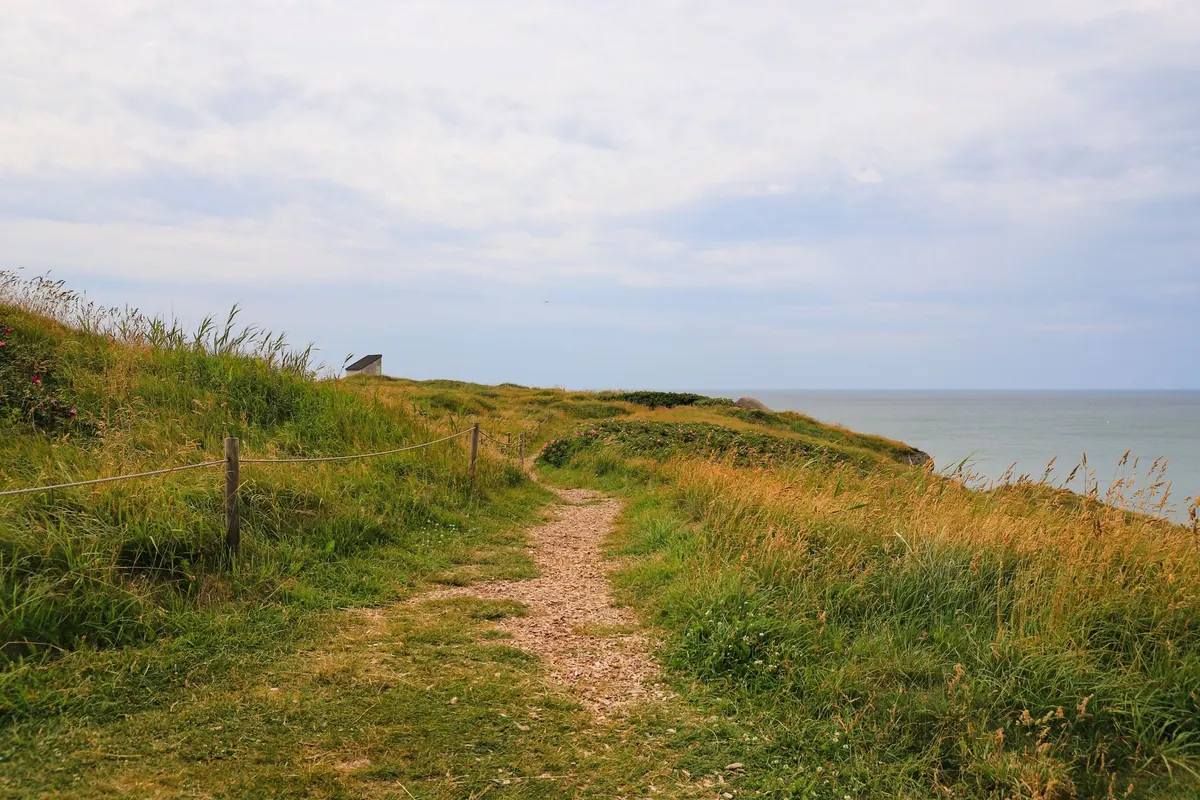
Photo: Christina & Peter / Pexels

You Might Also Like
A seasonal guide to matching the right book to the right spot — whether that's a windy beach, a sunny garden or a ten-minute train journey.
How to set up a book club that survives past the first meeting: who to invite, how often to meet, how to choose books, and how to keep the discussion warm.