A Beginner's Guide to Poetry: How to Read, Enjoy and Talk About Poems
Poetry has an image problem. Somewhere between school exams and the hunt for hidden meanings, plenty of people quietly decided that poems were a puzzle they weren't clever enough to solve. That's a shame, because poetry is one of the oldest and most portable pleasures going: it fits in a pocket, survives a bus journey, and can be finished in the time it takes to drink a cup of tea. You don't need a degree to enjoy it. You need a little patience, a willingness to read slowly, and a few simple moves.
The good news is that most of those moves aren't technical at all. They're closer to the things you already do when a song lyric gets stuck in your head, or when a friend says something so exactly right that you repeat it back to them. Reading a poem well is mostly a matter of paying attention on purpose — noticing what the words are doing rather than racing to the end to find out what they "mean."
What follows is a beginner's guide to that kind of attention: how to read a poem without feeling like you're back in an exam hall, how to get more out of it on a second and third pass, and how to talk about one when you'd like to say something more useful than "I liked it."
Begin with the sound, not the meaning
Read the poem aloud. It's the first piece of advice and the one most often skipped. Before poems were printed they were spoken, sung and remembered; sound isn't decoration, it's often the whole point.
Try it with a poem you half know. "I wandered lonely as a cloud / That floats on high o'er vales and hills" is doing several things at once, but the most immediate is rhythmic: the steady four beats keep drifting along, like the cloud. You don't need the word metre to feel that. You just need to hear it.
Emily Dickinson's "Hope is the thing with feathers" works the other way, in a light, skipping rhythm:
Hope is the thing with feathers
That perches in the soul
As you read, notice:
- where your voice slows down or hurries
- words that rhyme, half-rhyme or repeat
- lines that end before the sentence does, so the meaning spills into the next line
- any line odd enough to make you stop
- clusters of similar sounds — a run of soft s sounds, or hard k sounds, or long open os that slow everything down
- where you want to pause, and whether the poem seems to want that too
You're not cataloguing these things for a test. You're just noticing, the way you'd notice that someone's voice went quiet when they said something important.
Read it twice — at least
The first read is for sound. The second read is for sense: what is actually happening here? Who is speaking, and to whom? Where are they? Is there a story, an argument, a memory, a complaint?
The third read is for detail, and this is where poems open up. Go back to the words that snagged you. Ask why the poet chose that word and not the obvious one. Ask why the poem spends three lines on a window and half a line on a death. Poets are not usually paid by the word, so anything that survives into the final draft is probably there for a reason.
Two or three readings of a short poem take about four minutes. That's the entire cost of entry, and it's remarkable how much a poem changes between the first read and the third.
Pay attention to the line breaks
This is the single biggest difference between poetry and prose, and beginners often skip right past it. Where a line ends is a decision. It changes where you breathe, where you pause, and what you expect the next word to be.
William Carlos Williams made an entire famous poem out of this. In "The Red Wheelbarrow" he splits perfectly ordinary compound words across lines — wheel at the end of one, barrow at the start of the next; rain, then water. Nothing about the meaning changes. Everything about the pace does. The poem moves in small, careful steps, and you end up looking at the object as closely as the poem does.
Gwendolyn Brooks does something similar with a very different effect. In "We Real Cool" she puts the pronoun We at the end of her short lines rather than the beginning, so each line lands with a little thump: "We real cool. We / Left school." The rhythm is jazz, the line breaks are the beat, and the defiance in the voice comes partly from the shape on the page.
A quick test: read the poem as if it were a paragraph, running past every line ending. Then read it properly, respecting the breaks. If it feels different, the line breaks are doing work — and now you know where.
Look for the turn
Most poems change direction somewhere. Something shifts: the mood, the tense, the subject, the level of honesty. In a Shakespearean sonnet this happens almost exactly at line nine, and readers have a name for it — the volta, or turn. "Shall I compare thee to a summer's day?" spends eight lines being flattering and slightly anxious about summer's brevity, then turns and starts talking about something that will not fade.
You'll find turns everywhere once you start looking. Langston Hughes opens "Harlem" with a question — "What happens to a dream deferred?" — and the rest of the poem is a series of increasingly strange answers, each worse than the last. Mary Oliver's "The Summer Day" ends with a question that turns the whole poem back on the reader. Robert Frost's "Stopping by Woods on a Snowy Evening" finishes by repeating its final line word for word, and that repetition — which looks like an accident until you hear it — is the whole poem turning quietly on its heel.
Ask yourself: where did this poem stop being about one thing and start being about another? That moment is usually the heart of it.
Stop hunting for the one true meaning
Here is the myth that ruins poetry for more people than anything else: that each poem contains a single correct interpretation, buried by the poet, and that your job is to dig it up and be graded on it.
That isn't how poems work. A poem is a machine for making an experience happen in a reader, and different readers bring different lives to it. Two people can read the same eight lines and come away with different, equally well-supported readings. Both can be right. What matters is not whether you guessed the answer, but whether your reading is grounded in the words on the page.
A poem is not a riddle with an answer at the back of the book. It's an invitation to look at something closely, and you're allowed to accept it on your own terms.
Which also means you don't have to know what the poet "intended." You can't ask them, and it often isn't the most interesting question anyway. Ask instead: what is this poem doing to me, and how is it doing it?
How to talk about a poem without sounding pretentious
You don't need special vocabulary. You need to point at things. Here's a set of moves that works in a book group, a classroom, or a kitchen at midnight:
- Notice something specific. Not "it's about loss" but "it never says the word 'death' until the second-to-last line."
- Quote the line that did it. Reading four words aloud is a perfectly valid contribution.
- Describe your reaction honestly. "The last line stopped me" is real information about how the poem works.
- Ask a genuine question. "Why is it in the present tense?" is more interesting than any statement.
- Connect it to something. A song, a memory, another poem. Poems live in conversation.
- Listen to other readings. Someone else will notice something you walked straight past, every single time.
Helpful sentence starters, if you're stuck: I noticed that… · What surprised me was… · I'm not sure what to make of the line where… · It reminds me of… · Did anyone else read it as…? That's most of what literary criticism actually is, minus the jargon.
A five-minute practice that actually works
If you'd like poetry to become a habit rather than an obligation, try this once a day for a week:
- Pick one short poem — under twenty lines is plenty to start with.
- Read it aloud, slowly. Twice.
- Write down one line you liked and one line you didn't understand.
- Read it a third time, out loud again.
- Say or write one sentence about it. No more than that.
That's it. Five minutes, five moves. After a week you'll have spent half an hour with seven poems and — more importantly — you'll have got past the fear of not "getting" them.
Where to start finding poems
Don't begin with the heaviest thing on the shelf. Begin with something short, sharp and alive.
- Anthologies are the best value: a good "poems for the day" or "short poems" collection gives you dozens of voices for the price of one book.
- Free online archives such as the Poetry Foundation and Poets.org let you search by theme, era or length — useful when you want a poem about, say, autumn.
- Poetry podcasts and readings are a gentle way in if reading aloud still feels strange; hearing a poet read their own work teaches you more about line breaks than any explanation.
- Your local library's poetry shelf — pick three slim books at random and read the first poem in each.
- Song lyrics you already love are a legitimate starting point. Nobody is checking your credentials.
Give each poem about two minutes. If it hasn't caught you by the third read, move on without guilt. Poetry is a big room, and you're allowed to walk around until something makes you stop.
You don't have to like everything
One last thing. Liking every poem you read isn't the goal, and pretending to is how people end up resenting the whole art form. Some poems will leave you cold. Some will seem deliberately obscure. Some were written for a moment that isn't yours.
That's fine. You only need the handful that land — the ones you copy into a notebook, send to a friend, or think about on a bus. When one of those arrives, you'll know exactly what to do with it: read it aloud, read it again, and pass it on.
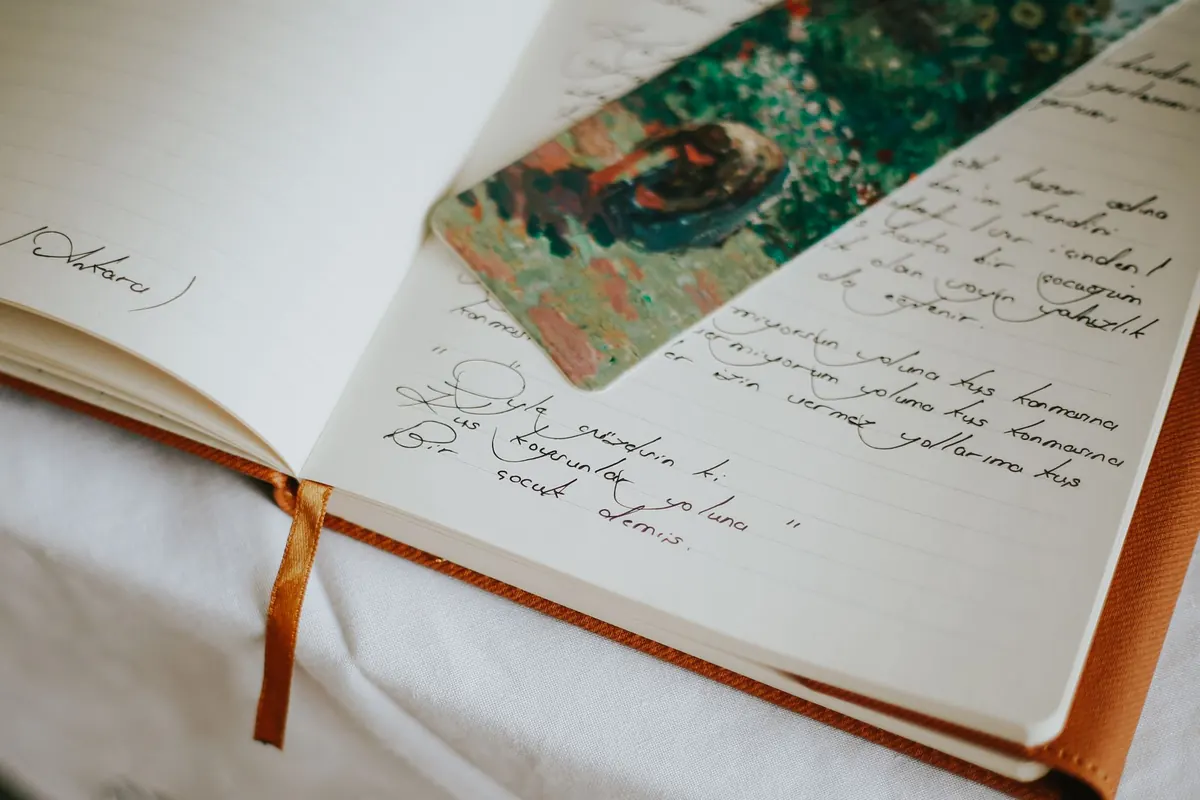
Photo: betül nur akyürek / Pexels

You Might Also Like
A thoughtful review of Raynor Winn's coastal memoir, with notes on its strengths and slow patches, who will enjoy it, and what to read next.
A seasonal guide to matching the right book to the right spot — whether that's a windy beach, a sunny garden or a ten-minute train journey.